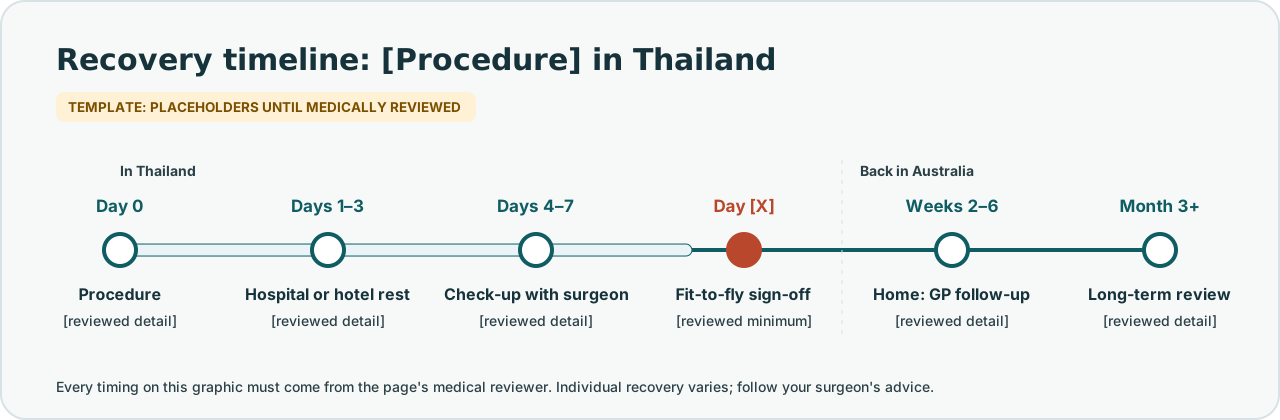
Short answer: There’s no single safe number of days. Advice varies a lot. The Australasian Society of Aesthetic Plastic Surgeons says patients in Australia and New Zealand are advised not to fly for 6 to 8 weeks after surgery because of clot risk (ASAPS (opens official site)). The UK’s NHS suggests not flying for 5 to 7 days after breast surgery or liposuction, and 7 to 10 days after facial procedures or tummy tucks (NHS (opens official site)). Airlines have their own rules too. Get a written fit-to-fly decision from your surgeon, and plan buffer days.
Risks and limitations to understand first
| Risk | What it means |
|---|---|
| Blood clots (DVT and pulmonary embolism) | Surgery and long-haul travel both raise clot risk (healthdirect (opens official site)). ASAPS warns that combining them can significantly increase the risk, and that flights of more than 4 hours have been found to increase it (ASAPS (opens official site)). |
| Higher-risk procedures | ASAPS notes that tummy tucks, body lifts and large-volume liposuction, where mobility afterwards is limited, add to clot risk (ASAPS (opens official site)). |
| Risk lasts weeks, not days | The US National Heart, Lung, and Blood Institute says clot risk is highest in the first 3 months after surgery (NHLBI (opens official site)). |
| Complications mid-flight | Bleeding, swelling or infection can be hard to manage in the air or at a transit airport. |
| Being denied boarding | Some airlines need medical clearance after certain operations, and won’t process it at the airport (Qantas (opens official site)). |
Because of these risks, the Australian Society of Plastic Surgeons cautions Australians against overseas cosmetic surgery and doesn’t recommend combining surgery with a holiday (Australian Society of Plastic Surgeons (opens official site)).
What the guidance says
| Source | Advice |
|---|---|
| Australasian Society of Aesthetic Plastic Surgeons | Patients in Australia and New Zealand are advised not to fly for 6 to 8 weeks after surgery. It also suggests ideally not planning travel for 3 months (ASAPS (opens official site)). |
| NHS (UK) | Don’t fly for 5 to 7 days after breast surgery or liposuction, or 7 to 10 days after facial procedures or tummy tucks (NHS (opens official site)). |
| American Society of Plastic Surgeons | Wait 5 to 7 days after body procedures such as liposuction and breast augmentation, and 7 to 10 days after facial procedures (American Society of Plastic Surgeons (opens official site)). |
| NICE (UK) | Treats major surgery within the previous 4 weeks as a high-risk factor for travel-related DVT, and says delaying travel may be appropriate (NICE CKS (opens official site)). |
The shorter UK and US timeframes are minimums for flights from overseas clinics to the UK or US. Flights home to Australia from Europe are often much longer. The medical reviewer should confirm how to present these differing figures.
Airline medical clearance
Each airline sets its own rules. As an example, Qantas says you need medical clearance if you have a condition listed on its Travel Clearance Form, or if you or your doctor aren’t sure you’re fit to travel. Your treating doctor completes the form, and it must be submitted at least five days before departure (Qantas (opens official site)). Qantas’s guidelines set procedure-specific timeframes for some operations (Qantas Medical Travel Clearance Guidelines (opens official site)).
Check your own airline’s requirements before you book the return flight, especially if you’ll transit through another carrier’s hub.
How long is the flight home?
| Route | Typical time | Source |
|---|---|---|
| Perth to Bali (Denpasar), non-stop | about 3.5 to 3.75 hours | FlightConnections (opens official site) |
| Sydney to Bali (Denpasar), non-stop | about 6.3 to 6.6 hours | FlightConnections (opens official site) |
| Sydney to Bangkok, non-stop | about 9.3 to 9.8 hours | 2LNR (opens official site) |
| Istanbul to Sydney, via Singapore | about 20 hours | AeroRoutes (opens official site) |
Destination details: Bali, Thailand, Bangkok, Phuket, Turkey, Istanbul and Antalya.
Reducing the risk on the flight
healthdirect suggests these steps on long journeys (healthdirect (opens official site)):
- Get up and walk around every 1 to 2 hours.
- Do calf stretches or heel lifts.
- Drink plenty of water, and avoid alcohol and caffeine.
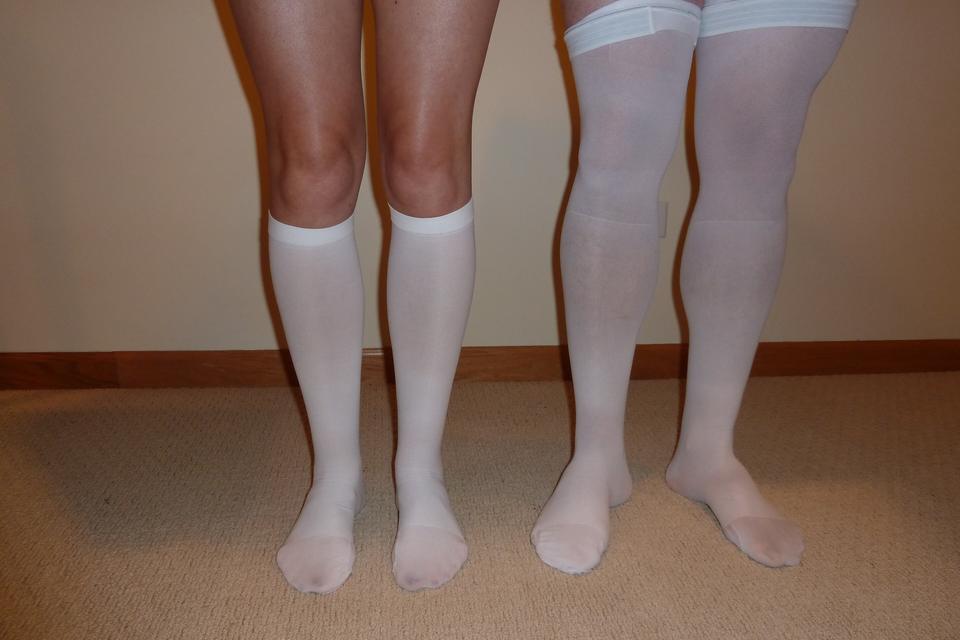
- Wear compression stockings if you have other DVT risk factors.
Ask your surgeon before you leave whether you need anything more for the flight. Don’t start any medicine to prevent clots without medical advice. Read more in our guide to DVT risk when flying after surgery.
Book flexibly. Choose a changeable fare, plan buffer days, and check that your insurance covers an extended stay. See travel insurance for surgery overseas and medical tourism insurance.
Procedure guides
Recovery and flying advice differs by procedure. See our guides to breast augmentation, tummy tucks, liposuction, rhinoplasty, the gastric sleeve, hip replacement, knee replacement, LASIK and dental implants.
Frequently asked questions
How many days after surgery can I fly?
There’s no single answer. ASAPS says patients in Australia and New Zealand are advised not to fly for 6 to 8 weeks after surgery. NHS guidance gives shorter minimums of 5 to 10 days, depending on the procedure. Your surgeon should decide, in writing.
Why is flying after surgery risky?
Surgery and long periods of sitting both increase the risk of blood clots in the legs, which can travel to the lungs. Combining them adds to that risk.
Do I need a medical certificate to fly after surgery?
Sometimes. Airlines set their own rules. Qantas, for example, needs a Travel Clearance Form for some conditions, submitted at least five days before departure.
Can I fly long-haul after a tummy tuck?
Tummy tucks are among the procedures ASAPS associates with higher clot risk. Ask your surgeon for specific advice, and allow extra recovery time.
What should I do on the flight to reduce clot risk?
Walk around every 1 to 2 hours, do calf exercises, drink water, avoid alcohol and caffeine, and wear compression stockings if you have other risk factors.
What are the warning signs of a clot after flying?
Pain, swelling or warmth in one leg, or chest pain and sudden breathlessness. Chest symptoms are an emergency, so call 000.
Sources
All accessed 22 October 2026.
- Australasian Society of Aesthetic Plastic Surgeons, Heading overseas for cosmetic surgery?: https://aestheticplasticsurgeons.org.au/news/heading-overseas-for-cosmetic-surgery-heres-what-you-need-to-know/
- ASAPS, Thinking of having cosmetic surgery overseas? Know your risks: https://aestheticplasticsurgeons.org.au/resources/thinking-of-having-cosmetic-surgery-overseas-know-your-risks-2/
- Australian Society of Plastic Surgeons, Cosmetic tourism is a price-driven practice: https://plasticsurgery.org.au/information-for-patients/cosmetic-tourism-is-a-price-driven-practice/
- NHS, Cosmetic surgery abroad: https://www.nhs.uk/tests-and-treatments/cosmetic-procedures/advice/cosmetic-surgery-abroad/
- American Society of Plastic Surgeons, Briefing paper: cosmetic surgery tourism: https://www.plasticsurgery.org/news/briefing-papers/briefing-paper-cosmetic-surgery-tourism
- NICE CKS, DVT prevention for travellers: https://cks.nice.org.uk/topics/dvt-prevention-for-travellers/management/dvt-prevention-for-travellers/
- NHLBI, Preventing blood clots: https://www.nhlbi.nih.gov/health/venous-thromboembolism/preventing-blood-clots
- healthdirect, Deep vein thrombosis: https://www.healthdirect.gov.au/deep-vein-thrombosis
- Qantas, Fitness to fly: https://www.qantas.com/au/en/travel-info/specific-needs/fitness-to-fly.html
- Qantas, Medical travel clearance guidelines: https://www.qantas.com/content/dam/qantas/pdfs/fly/specific-needs/qantas-medical-clearance-guidelines.pdf
- FlightConnections, 2LNR and AeroRoutes route data (linked in the table above)
Disclaimer: The information on medicaltourism.com.au is general in nature. It isn’t medical, legal, financial, travel or insurance advice and doesn’t take your personal circumstances into account. All surgery carries risks. Talk to a registered health practitioner before deciding on any procedure or travel. See our editorial policy, medical disclaimer and how we make money.