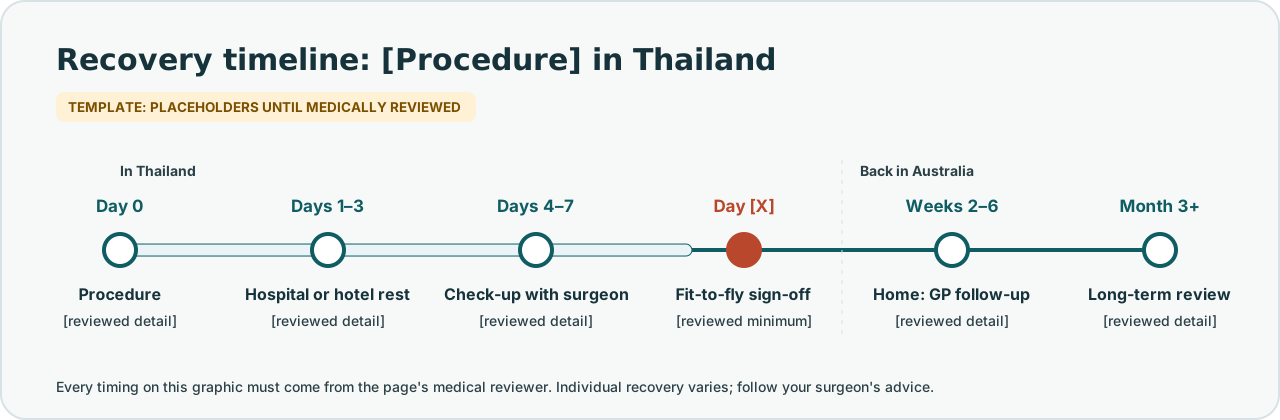
Short answer: Plan your aftercare before you book, not after you land. Talk to your GP first, and ask the overseas provider in advance for a full treatment summary in English. See your GP soon after you get home. The Royal Australian College of General Practitioners says it’s useful for GPs to be involved at every step, including receiving a summary of the treatment and any follow-up needed (RACGP (opens official site)). Medicare doesn’t cover treatment overseas, and cosmetic revision at home is usually at your own cost.
Risks and limitations to understand first
| Risk | What it means |
|---|---|
| Complications can appear weeks later | ASAPS notes that many complications emerge weeks after surgery, and that the original overseas surgeon may not be able to provide follow-up (ASAPS (opens official site)). |
| A new team at extra cost | The Australian Society of Plastic Surgeons says that once you’re home, ongoing care would need to be with a new surgical team, at additional cost (Australian Society of Plastic Surgeons (opens official site)). |
| Missing records | Without full records, Australian practitioners may struggle to continue or repair treatment. The ADA raises this for dental work in particular (ADA (opens official site)). |
| Cover gaps | Medicare doesn’t cover optional treatment such as elective cosmetic surgery (privatehealth.gov.au (opens official site)). Health insurers don’t pay benefits for cosmetic surgery (Commonwealth Ombudsman (opens official site)). |

Before you go
- See your GP. Smartraveller advises talking to your doctor in Australia about your plans and getting a health check at least 6 weeks before you go (Smartraveller (opens official site)). For cosmetic surgery in Australia, a GP referral has been required since 1 July 2023 (Ahpra (opens official site)). Overseas providers aren’t bound by that rule, but your GP’s input still matters.
- Agree who will see you afterwards. Ask your GP whether they’ll review you on return, and how you’d get a specialist referral if needed.
- Ask the overseas provider in writing what follow-up they offer remotely, and what happens if you need a revision.
- Budget for complications. Smartraveller says fixing a complication can cost much more than the original treatment (Smartraveller (opens official site)).
- Get the right insurance. See travel insurance for surgery overseas and medical tourism insurance.
Checking providers: how to choose a surgeon overseas and questions to ask before you book.
Records to bring home
The World Medical Association says patients should receive copies of their medical documents for continuity of care, including expected recovery time and when travel home is possible (WMA (opens official site)). Ask for these, in English:
- operation notes and discharge summary
- implant details: brand, size, lot or batch number, and an implant card
- graft counts (hair) or materials used (dental)
- pathology results and imaging, including dental X-rays
- the medicines you were given, and any you were sent home with
- wound care and follow-up instructions
- your surgeon’s contact details and registration number
When you’re back
- Book a GP visit within your first few days, even if you feel well. Bring your records.
- Know the warning signs: fever, spreading redness, wound breakdown, a swollen calf, chest pain or breathlessness. See what to do if surgery overseas goes wrong.
- Not sure how urgent it is? Call healthdirect on 1800 022 222, 24 hours a day (healthdirect (opens official site)).
- Emergencies: call 000 or go to the nearest emergency department.
- Dental work: see an Australian dentist for review and maintenance. The ADA recommends talking to an Australian dentist before considering treatment overseas (ADA (opens official site)).
What it may cost
| Care | Who usually pays |
|---|---|
| Emergency care in a public hospital | Free as a public patient if you’re eligible for Medicare (privatehealth.gov.au (opens official site)) |
| GP review | Depends on your GP’s billing |
| Cosmetic revision | Usually you. Medicare and health insurers don’t cover cosmetic surgery |
| Medically necessary complication care | May attract Medicare and private health benefits, depending on your policy. Check in writing |
See revision surgery in Australia, does Medicare cover surgery overseas? and health insurance gaps.
By procedure
Follow-up needs vary. See our guides to breast augmentation, tummy tucks, the gastric sleeve, dental implants, veneers, hair transplants and hip replacement.
Frequently asked questions
Will my GP look after me after surgery overseas?
Many GPs will review you and arrange tests or referrals. Talk to your GP before you go, and bring full records home.
What records should I get from the overseas clinic?
Operation notes, discharge summary, implant details, imaging and pathology, a medication list, aftercare instructions and the surgeon’s contact details, all in English.
Who pays if I need revision surgery in Australia?
Usually you, for cosmetic revision. Medicare and health insurers don’t cover cosmetic surgery. Medically necessary care for a complication may be covered, depending on your circumstances.
How soon should I see a doctor after I get home?
Within the first few days, even if you feel well. Sooner if you have any warning signs.
Can Australian surgeons fix work done overseas?
Some will assess and treat you, but it may involve a new surgical team and extra cost. Records make it much easier.
Sources
All accessed 22 October 2026.
- RACGP, Medical tourism (AFP 2015): https://www.racgp.org.au/afp/2015/january-february/medical-tourism
- World Medical Association, Statement on medical tourism: https://www.wma.net/policies-post/wma-statement-on-medical-tourism/
- ASAPS, Heading overseas for cosmetic surgery?: https://aestheticplasticsurgeons.org.au/news/heading-overseas-for-cosmetic-surgery-heres-what-you-need-to-know/
- Australian Society of Plastic Surgeons, Cosmetic tourism is a price-driven practice: https://plasticsurgery.org.au/information-for-patients/cosmetic-tourism-is-a-price-driven-practice/
- Australian Dental Association, Policy Statement 2.2.6: https://ada.org.au/policy-statement-2-2-6-elective-overseas-dental-treatment
- Ahpra, Thinking about having cosmetic surgery?: https://www.ahpra.gov.au/Resources/Cosmetic-surgery-hub/Information-for-the-public.aspx
- Smartraveller, Medical tourism: https://www.smartraveller.gov.au/medical-tourism
- Smartraveller, Sun, sand and cosmetic surgery: https://www.smartraveller.gov.au/news-and-updates/sun-sand-and-surgery
- healthdirect, Contact us: https://www.healthdirect.gov.au/contact-us
- privatehealth.gov.au, What is covered by private health insurance?: https://privatehealth.gov.au/health_insurance/what_is_covered/privatehealth.htm
- Commonwealth Ombudsman, Plastic and reconstructive surgery: https://www.ombudsman.gov.au/publications-and-news-pages/publication-pages/brochures-and-factsheets/factsheets/private-health-insurance/plastic-and-reconstructive-surgery
Disclaimer: The information on medicaltourism.com.au is general in nature. It isn’t medical, legal, financial or insurance advice and doesn’t take your personal circumstances into account. Talk to a registered health practitioner before deciding on any procedure. See our editorial policy, medical disclaimer and how we make money.