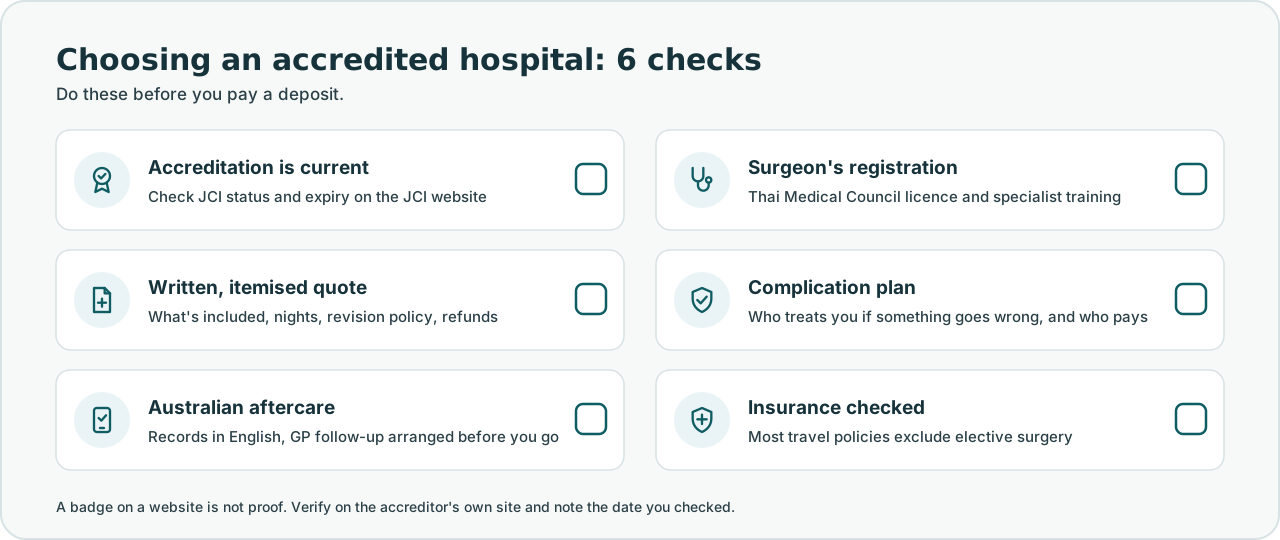
Short answer: An agency can book flights, hotels and appointments, but it doesn’t perform your treatment and usually can’t control it. Ask exactly what it does, how it’s paid (including any commission from clinics), and what happens if something goes wrong. Then check the surgeon and facility yourself, using how to choose a surgeon overseas.
Risks and limitations to understand first
| Risk | What it means |
|---|---|
| Legal recourse is uncertain | A 2021 article in the Australian Lawyers Alliance journal Precedent notes that facilitators’ liability for overseas treatment is yet to be tested in Australian courts (Precedent, via AustLII (opens official site)). |
| No international complaints system | RACS notes there’s no standard international complaints system if something goes wrong (RACS position paper (opens official site)). |
| Providers may carry no liability | The Better Health Channel notes that most facilities offer medical tourism services without liability, so the patient carries the risk (Better Health Channel (opens official site)). |
| Commercial incentives | An agency paid by clinics has a reason to steer you. Ask how it’s paid. |
| Insurance gaps remain | An agency booking does not create Medicare cover overseas or fix travel-policy exclusions (Smartraveller (opens official site)). |

What agencies do
The Precedent article describes a range: some facilitators only book flights, accommodation and appointments, while others communicate with doctors, link Australian and overseas doctors, and coordinate care after you get home (Precedent (opens official site)). Get the agency’s role in writing, because it shapes what you can expect from it.
Agencies are not a substitute for:
- Verifying the surgeon on the official register for that country
- Reading the hospital consent form yourself
- Arranging insurance that matches planned treatment
- Planning GP follow-up in Australia before you travel
Hub pages: clinics and agencies, clinics hub.
Your rights under Australian Consumer Law
When you buy services from an Australian business, consumer guarantees apply. Services must be provided with due care and skill, be fit for any purpose you made known, and be supplied within a reasonable time (ACCC (opens official site)). If you book travel through an agent, check both the agent’s and the provider’s terms (ACCC (opens official site)).
These rights apply to the agency’s own services. They may not reach the overseas clinic. Misleading claims about outcomes, “guaranteed” results or undisclosed commissions can raise separate ACL issues; get advice if you think you were misled. This site is not a complaints body.
Checklist before you pay
- Who are you? Business name, ABN if Australian, address and how long you’ve operated.
- What exactly do you do? Booking only, or care coordination too? In writing.
- How are you paid? By me, by the clinic, or both? What commission do you receive? The ACCC says commercial relationships should be disclosed clearly (ACCC (opens official site)).
- Which surgeon, which facility? Get names and registration numbers, then check them on the official registers. See choosing a surgeon.
- Who pays if things go wrong? Extra nights, a changed flight, hospital transfer, revision.
- What follow-up do you arrange once I’m back in Australia?
- Refunds and cancellation: what are the terms for the agency fee and the clinic deposit?
- Insurance: do you require or arrange cover? See travel insurance for surgery.
- Records: will you help me get notes and implant details in English? See aftercare in Australia.
- Quotes: are clinical fees itemised separately from hotel and tour components?
Use our questions to ask before you book for the clinical side. Package marketing context: plastic surgery packages in Thailand explained.
Red flags
- Pressure to pay a deposit quickly
- No named surgeon until you arrive
- Before-and-after galleries, testimonials or “guaranteed” results used to sell
- Packages that focus on hotels and tours over medical care (ISHRS (opens official site))
- Refusal to say how the agency is paid
- Claims that Medicare or Australian private health will quietly cover overseas elective care (generally false for planned medical tourism)
After you pay: records and escalation
Keep copies of every quote, receipt, consent form, implant card and discharge summary. If something goes wrong overseas, document dates and names, contact the hospital in writing, and talk to your Australian GP early. Guides: complications after surgery overseas, revision surgery in Australia.
If the dispute is about the Australian agency’s own booking service, ACCC and state fair-trading pathways may be relevant for that service. They are not a shortcut to sue an overseas surgeon. Get independent legal advice for your facts.
Destinations and procedures
- Country guides: Thailand, Bali and Turkey; safety guides for Thailand, Bali and Turkey
- Cities: Bangkok, Phuket and Istanbul
- Packages: plastic surgery packages in Thailand explained
- Procedures: dental implants, hair transplants and the gastric sleeve
Frequently asked questions
Do I need an agency for medical tourism?
No. Some people book directly. Either way, check the surgeon and facility yourself.
Can I sue an agency if surgery goes wrong?
It’s uncertain. Facilitators’ liability for overseas treatment hasn’t been tested in Australian courts. Get legal advice if you’re harmed.
Do agencies get paid by clinics?
Some do. Ask directly and get the answer in writing.
Does Australian Consumer Law protect me?
Consumer guarantees apply to services you buy from Australian businesses, including the agency’s own services. They may not cover the overseas clinic.
What should I get in writing?
The agency’s role, fees and commissions, the named surgeon and facility, what happens if something goes wrong, and refund terms.
Can an agency guarantee a surgical result?
No credible agency can. Outcome guarantees are a red flag under clinical and advertising norms.
Sources
All accessed 24 October 2026.
- Baigent and Vallance, Medical tourism: problems and potential avenues for recourse, Precedent 163 (2021): https://www.austlii.edu.au/cgi-bin/viewdoc/au/journals/PrecedentAULA/2021/17.html
- RACS, Medical tourism position paper: https://www.surgeons.org/-/media/Project/RACS/surgeons-org/files/position-papers/2017-06-29_pos_fes-pst-026_medical_tourism.pdf
- Better Health Channel, Medical tourism and insurance: https://www.betterhealth.vic.gov.au/health/HealthyLiving/medical-tourism
- ACCC, Consumer rights and guarantees: https://www.accc.gov.au/consumers/buying-products-and-services/consumer-rights-and-guarantees
- ACCC, Travel delays and cancellations: https://www.accc.gov.au/consumers/specific-products-and-activities/travel-delays-and-cancellations
- ACCC, Advice for social media influencers: https://www.accc.gov.au/business/advertising-and-promotions/social-media-and-online-reviews/advice-for-social-media-influencers
- ISHRS, Hair transplant black market red flags: https://fightthefight.ishrs.org/hair-transplant-black-market-red-flags/
- Smartraveller, Medical tourism: https://www.smartraveller.gov.au/travel-essentials/travel-health/medical-tourism
Disclaimer: The information on medicaltourism.com.au is general in nature. It isn’t medical, legal, financial or insurance advice and doesn’t take your personal circumstances into account. Talk to a registered health practitioner before deciding on any procedure. See our editorial policy, medical disclaimer and how we make money.